🎏 Naming the Radial Analog LED Watch
TL;DR: I built Amber Dial, a 38 mm wristwatch where the circuit board is the watch. It has no case and no hands, and 72 amber LEDs show the time by position, like an analog dial. When I tried to describe it, every obvious name already meant something else. I landed on “radial analog LED watch,” and along the way found out Motorola patented nearly the same layout in 1971. PCBWay sponsored the build.
Disclosure: PCBWay sponsored this project with a credit toward fabrication and assembly. Links to PCBWay in this post use my referral link, and I earn a small commission if you sign up and order through it.
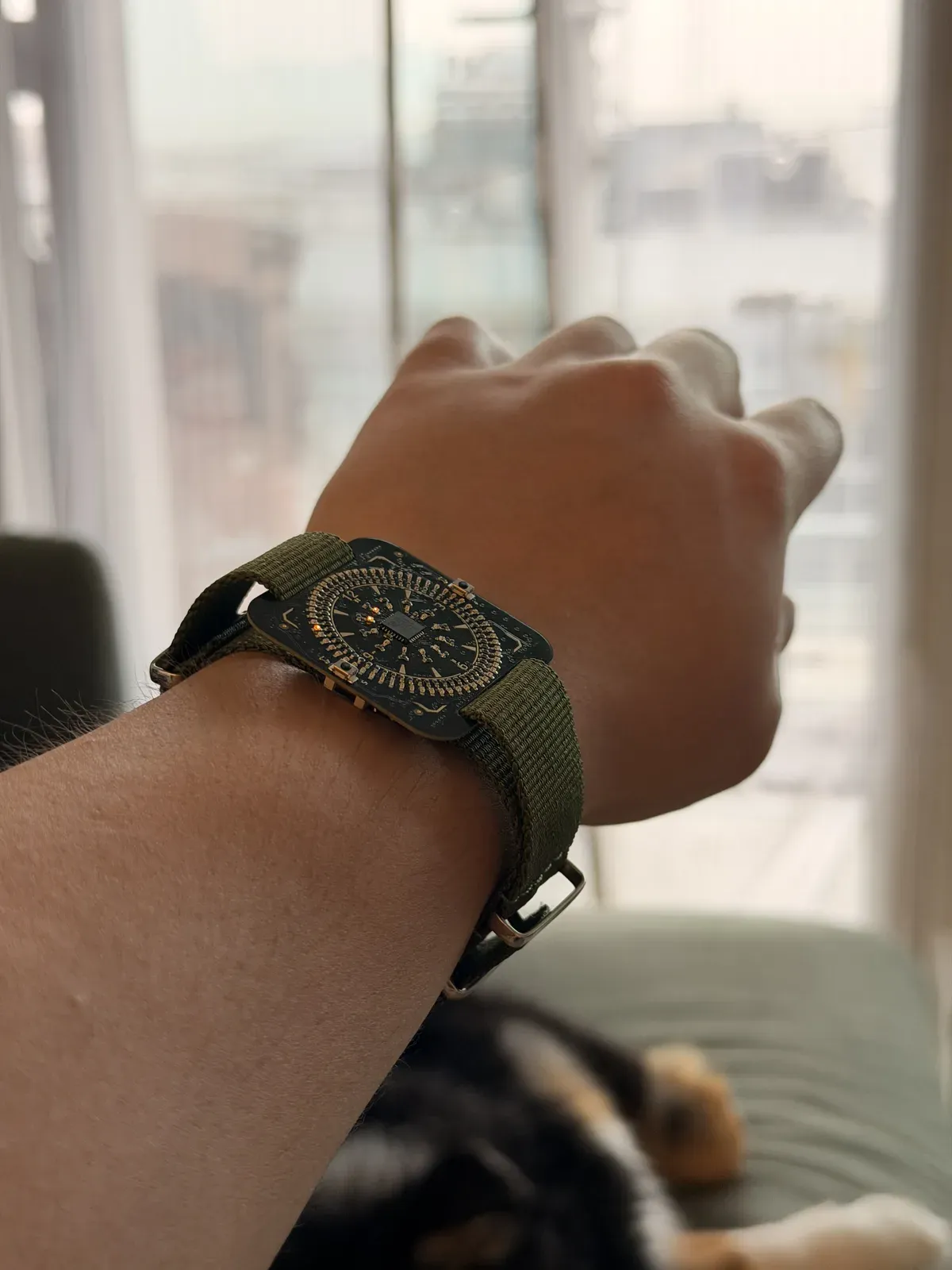
The real watch, from the side. How it got built is its own post, with more photos, a video of it matching my alarm clock, and notes on how it feels to wear.
Why I built a watch
PCBWay offered to sponsor a project, and I wanted to make something I’d actually enjoy wearing and that looked like nothing else on my desk. Most sponsored PCB projects are dev boards or keyboards. They’re useful, but they all look the same in a photo—a green or black rectangle with some chips on it. I wanted the board itself to be the object.
So the idea was a watch with no case at all. One 0.8 mm board is the whole body. The black solder mask is the dial. The gold you see is ENIG plating—the same gold finish that protects any circuit board’s pads—except here some of it is decoration: numerals, tapered hour markers, little shoulders at the corners. Some of the gold spokes are real LED traces doing double duty as dial markings, which I love. A NATO strap threads through 2 slots cut right into the board, and a coin cell sits on the back.
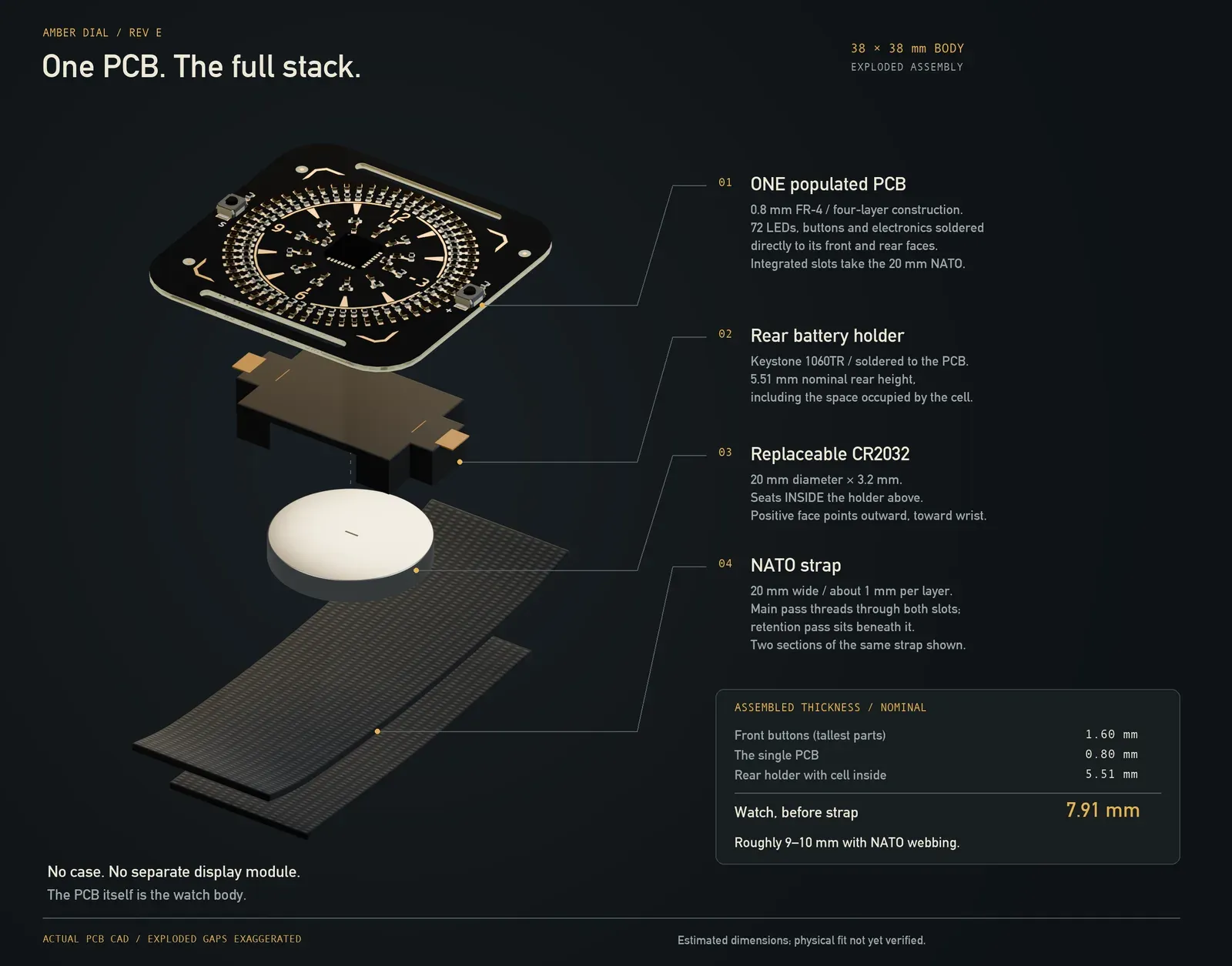
That’s the whole watch. One board, one battery, one strap.
How it tells time
There are 60 LEDs in the outer ring for minutes and seconds, and 12 in the inner ring for hours. You read it like a normal watch: where the light is tells you the time.
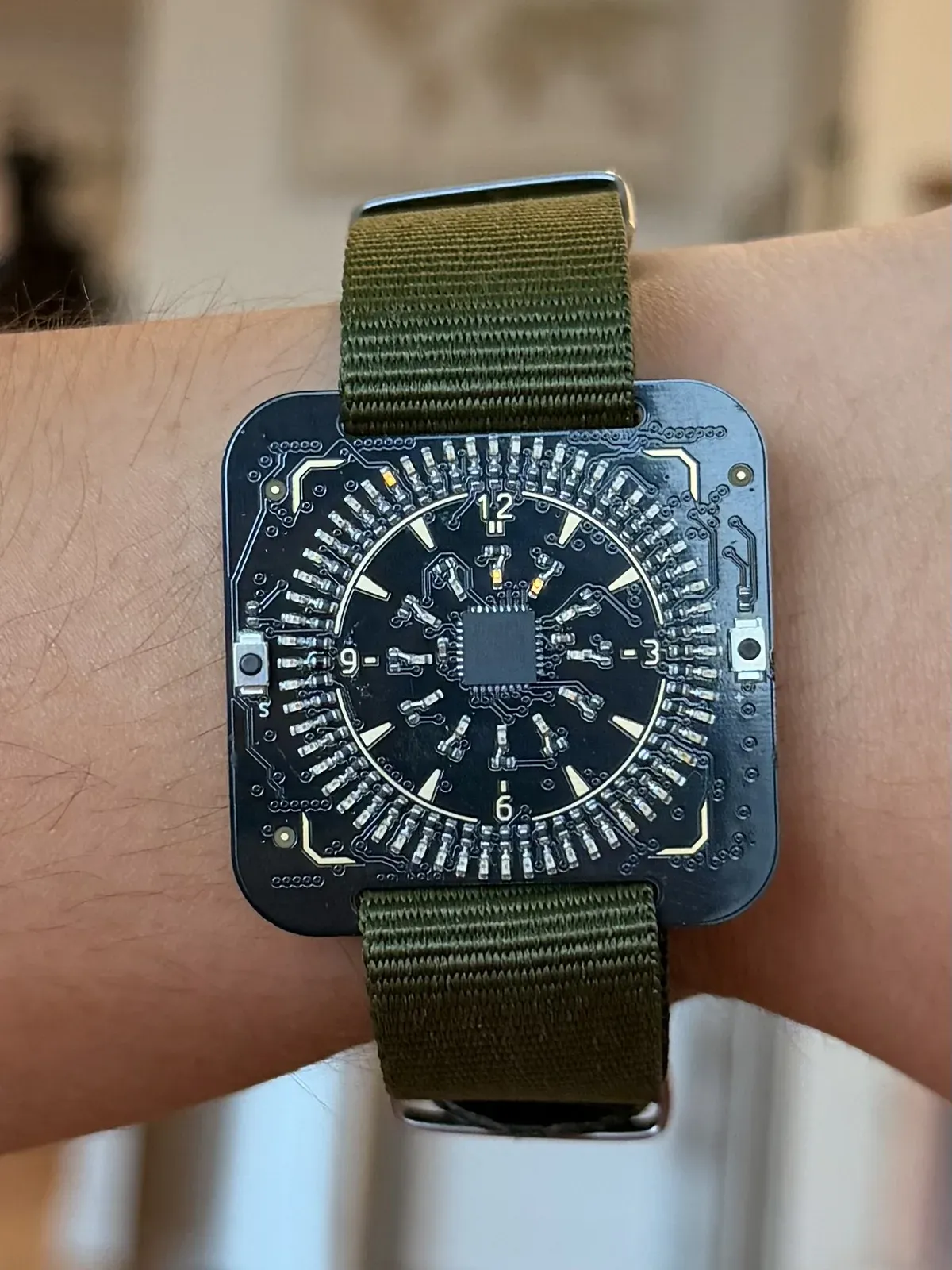
Face-on: the outer ring of 60 LEDs, the gold numerals, and the chip in the middle that runs it all.
The hour ring took one real design decision. My first version crossfaded—as 1 o’clock moved toward 2, the “1” LED dimmed while the “2” brightened. It looked smooth in the simulator, but at 1:55 I honestly couldn’t tell which hour it was. Both LEDs were about the same brightness. So the firmware now holds the current hour at full brightness while the next one fades in, and at the top of the hour the old hour turns off. A physical hour hand can’t do that, which I think is kind of nice—it borrows analog’s layout but uses a trick only light can do.
The real watch at night, at 10:07 after its show-mode animation. Hour 10 is at full brightness while 11 has just started to fade in.
Timekeeping comes from a tiny real-time clock chip with a built-in 32.768 kHz quartz crystal, rated ±1 ppm at room temperature[1]. That’s roughly 2.6 seconds a month, which is better than most cheap quartz watches. (The back of the board says CAL. 2^15 / 32768 Hz, a little nod to that crystal that’s normally hidden under the strap.)
Building it with PCBWay
PCBWay fabricated, assembled, programmed and tested the watch, and it arrived on November 6 keeping time on the first boot. The full story—the back-and-forth with their engineers, what it cost, and a small unboxing panic—is in This Circuit Board Is a Watch.
The naming problem
Once the design was done, I tried to describe it in one line and got stuck.
My first instinct was “digital analog watch.” It’s digital inside and analog in how you read it, so that seemed right. Then I searched it.
The Google Images test
Every result was a watch with regular hands plus a little LCD showing digital numbers—what watch people call an “ana-digi.” Casio makes a million of them. That’s not my watch at all.
This turned into a test I’d recommend for naming anything:
- Search Google Images for your candidate name.
- If the results show a different object, the name is taken—even if it’s technically accurate.
Words carry what people have already seen. “Digital analog watch” might describe mine correctly in the abstract, but nobody reading it would picture it.
My next idea was “skeuomorphic,” the word for a design that copies the look of an older thing it no longer needs to copy (like the old iPhone Notes app being yellow legal paper). My watch has no hands, no motor and no gears, but it insists on telling time like it has hands. That irony is what I find interesting about it. But I don’t think it works as a name. Watch people use “analog” and “digital” to describe the display, not the insides—a normal quartz watch is fully electronic, but it’s still analog because you read it from hands. By that definition, my watch really is analog. The layout isn’t decoration; it’s how you read the time.
What helped was splitting the watch into 3 separate things:
| Classic LED watch | Amber Dial | |
|---|---|---|
| Timekeeping | Quartz | Quartz |
| Display made of | LEDs | LEDs |
| Display format | Numbers | Position on a dial |
The 1970s LED watch—the Hamilton Pulsar was the famous one[2]—matches mine on 2 of 3. The only difference is the format, and there’s already a word for “time read by position on a dial”: analog.
So I ended up with “radial analog LED watch.” “Radial” and “analog” overlap a little, but I think you need both. When people hear “LED watch,” they picture red numbers, and it takes 2 words to knock that out of their head.
It turns out this was invented in 1971
The other half of the Google Images test is searching the obvious neighbors too—“LED ring watch,” “72 LED watch.” That’s where things got funny.
I designed this watch without looking at any prior art. I just wanted something that looked cool. Then, while trying to name it after the fact, I found 2 Motorola patents filed on the same day in May 1971. One describes “60 light emitting diodes … arranged in a ring” for minutes and seconds, and “an inner concentric ring of 12 light emitting diodes” for the hour[3]. The other describes the same 72-LED layout, plus an 84-LED version with half-hour markers[4]. Both run off a crystal oscillator.
That’s my layout. Same 60, same 12, same idea of reading position instead of numbers. I got there independently 55 years later.
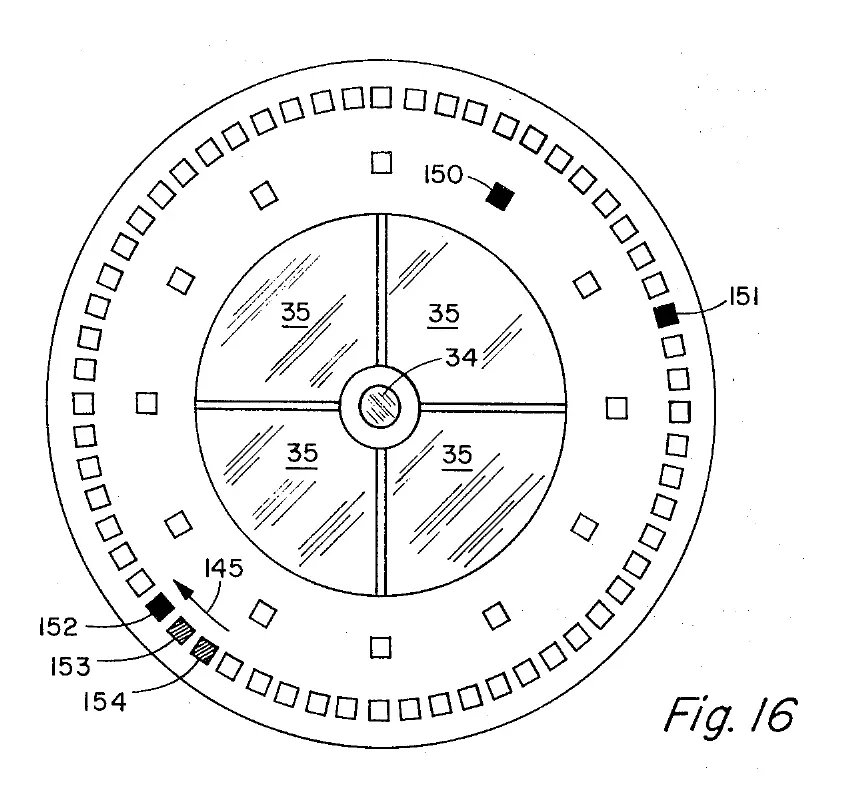
Fig. 16 from Motorola’s US 3,757,511, filed in May 1971: 60 LEDs outside, 12 inside, and the filled squares are the lit ones. The 4 wedges in the middle are solar cells.
Motorola actually built one. A December 1971 Popular Electronics piece shows a research-prototype desk clock from Motorola’s semiconductor division with 72 LEDs and “an extremely accurate quartz crystal,” running about a year on 2 small batteries[5]. A few years later, Jack Kilby—yes, the integrated circuit Jack Kilby—filed a patent for a single 60-LED ring version and cited the Motorola patents as prior work[6].
And then the idea mostly disappeared. The LED watches that actually sold, like the Pulsar, showed numbers. My guess is that numbers just made a better pitch for “the future” in the 1970s—if you’re selling a space-age watch, you probably want it to look nothing like your grandfather’s. The ring layout lived on in odd corners: Tokyoflash made some watches with sweeping light “hands”[7], and there’s a whole genre of hobbyist PCB watches with LED rings[8]. But it never got one common name. Hobbyists call theirs “analog-style LED watches,” “72 LED analog wristwatches,” “LED ring watches.”
I think that’s why I couldn’t find a name. I didn’t invent a new thing; I rebuilt an old one that lost before anyone named it.
That changes what I’d claim is mine. Not the concept—Motorola had that in 1971. What’s mine is the execution: a case-free watch where the board is the finished object, the held-hour fade, and a quartz chip accurate to a couple seconds a month that runs off a coin cell.
Citations
[1] RV-3028-C7 Real-Time Clock Module — Micro Crystal ↩
[2] Pulsar (watch) — Wikipedia ↩
[3] US 3,754,392: Apparatus for driving a light emitting diode of horologic display — Motorola, filed 1971-05-17 ↩
[4] US 3,757,511: Light emitting diode display for electronic timepiece — Motorola, filed 1971-05-17 ↩
[5] "$25,000 Sundial," Popular Electronics, December 1971 (reprint) — RF Cafe ↩
[6] US 3,955,354: Display for electronic clocks and watches — Kilby & Schweitzer, filed 1974-02-11 ↩
[7] Tokyoflash Radar watch — Yanko Design ↩
[8] LumiDial: a 72 LED analog wristwatch — Hackster ↩
> TL;DR: I built Amber Dial, a 38 mm wristwatch where the circuit board is the watch. It has no case and no hands, and 72 amber LEDs show the time by position, like an analog dial. When I tried to describe it, every obvious name already meant something else. I landed on "radial analog LED watch," and along the way found out Motorola patented nearly the same layout in 1971. PCBWay sponsored the build.
*Disclosure: PCBWay sponsored this project with a credit toward fabrication and assembly. Links to PCBWay in this post use [my referral link](https://pcbway.com/g/MRMzcM), and I earn a small commission if you sign up and order through it.*

*The real watch, from the side. [How it got built](/this-circuit-board-is-a-watch.md) is its own post, with more photos, a video of it matching my alarm clock, and notes on how it feels to wear.*
## Why I built a watch
PCBWay offered to sponsor a project, and I wanted to make something I'd actually enjoy wearing and that looked like nothing else on my desk. Most sponsored PCB projects are dev boards or keyboards. They're useful, but they all look the same in a photo—a green or black rectangle with some chips on it. I wanted the board itself to be the object.
So the idea was a watch with no case at all. One 0.8 mm board is the whole body. The black solder mask is the dial. The gold you see is ENIG plating—the same gold finish that protects any circuit board's pads—except here some of it is decoration: numerals, tapered hour markers, little shoulders at the corners. Some of the gold spokes are real LED traces doing double duty as dial markings, which I love. A NATO strap threads through 2 slots cut right into the board, and a coin cell sits on the back.

*That's the whole watch. One board, one battery, one strap.*
## How it tells time
There are 60 LEDs in the outer ring for minutes and seconds, and 12 in the inner ring for hours. You read it like a normal watch: where the light is tells you the time.

*Face-on: the outer ring of 60 LEDs, the gold numerals, and the chip in the middle that runs it all.*
The hour ring took one real design decision. My first version crossfaded—as 1 o'clock moved toward 2, the "1" LED dimmed while the "2" brightened. It looked smooth in the simulator, but at 1:55 I honestly couldn't tell which hour it was. Both LEDs were about the same brightness. So the firmware now holds the current hour at full brightness while the next one fades in, and at the top of the hour the old hour turns off. A physical hour hand can't do that, which I think is kind of nice—it borrows analog's layout but uses a trick only light can do.
<video src="/videos/amber-dial-night-show-mode.mp4" autoplay muted playsinline loop width="360"></video>
*The real watch at night, at 10:07 after its show-mode animation. Hour 10 is at full brightness while 11 has just started to fade in.*
Timekeeping comes from a tiny real-time clock chip with a built-in 32.768 kHz quartz crystal, rated ±1 ppm at room temperature<sup><a href="#cite-1" id="ref-1">[1]</a></sup>. That's roughly 2.6 seconds a month, which is better than most cheap quartz watches. (The back of the board says `CAL. 2^15 / 32768 Hz`, a little nod to that crystal that's normally hidden under the strap.)
## Building it with PCBWay
PCBWay fabricated, assembled, programmed and tested the watch, and it arrived on November 6 keeping time on the first boot. The full story—the back-and-forth with their engineers, what it cost, and a small unboxing panic—is in [This Circuit Board Is a Watch](/this-circuit-board-is-a-watch.md).
## The naming problem
Once the design was done, I tried to describe it in one line and got stuck.
My first instinct was "digital analog watch." It's digital inside and analog in how you read it, so that seemed right. Then I searched it.
## The Google Images test
Every result was a watch with regular hands plus a little LCD showing digital numbers—what watch people call an "ana-digi." Casio makes a million of them. That's not my watch at all.
This turned into a test I'd recommend for naming anything:
1. Search Google Images for your candidate name.
2. If the results show a different object, the name is taken—even if it's technically accurate.
Words carry what people have already seen. "Digital analog watch" might describe mine correctly in the abstract, but nobody reading it would picture it.
My next idea was "skeuomorphic," the word for a design that copies the look of an older thing it no longer needs to copy (like the old iPhone Notes app being yellow legal paper). My watch has no hands, no motor and no gears, but it insists on telling time like it has hands. That irony is what I find interesting about it. But I don't think it works as a name. Watch people use "analog" and "digital" to describe the display, not the insides—a normal quartz watch is fully electronic, but it's still analog because you read it from hands. By that definition, my watch really is analog. The layout isn't decoration; it's how you read the time.
What helped was splitting the watch into 3 separate things:
| | Classic LED watch | Amber Dial |
|---|---|---|
| Timekeeping | Quartz | Quartz |
| Display made of | LEDs | LEDs |
| Display format | Numbers | Position on a dial |
The 1970s LED watch—the Hamilton Pulsar was the famous one<sup><a href="#cite-2" id="ref-2">[2]</a></sup>—matches mine on 2 of 3. The only difference is the format, and there's already a word for "time read by position on a dial": analog.
So I ended up with "radial analog LED watch." "Radial" and "analog" overlap a little, but I think you need both. When people hear "LED watch," they picture red numbers, and it takes 2 words to knock that out of their head.
## It turns out this was invented in 1971
The other half of the Google Images test is searching the obvious neighbors too—"LED ring watch," "72 LED watch." That's where things got funny.
I designed this watch without looking at any prior art. I just wanted something that looked cool. Then, while trying to name it after the fact, I found 2 Motorola patents filed on the same day in May 1971. One describes "60 light emitting diodes … arranged in a ring" for minutes and seconds, and "an inner concentric ring of 12 light emitting diodes" for the hour<sup><a href="#cite-3" id="ref-3">[3]</a></sup>. The other describes the same 72-LED layout, plus an 84-LED version with half-hour markers<sup><a href="#cite-4" id="ref-4">[4]</a></sup>. Both run off a crystal oscillator.
That's my layout. Same 60, same 12, same idea of reading position instead of numbers. I got there independently 55 years later.

*Fig. 16 from Motorola's US 3,757,511, filed in May 1971: 60 LEDs outside, 12 inside, and the filled squares are the lit ones. The 4 wedges in the middle are solar cells.*
Motorola actually built one. A December 1971 Popular Electronics piece shows a research-prototype desk clock from Motorola's semiconductor division with 72 LEDs and "an extremely accurate quartz crystal," running about a year on 2 small batteries<sup><a href="#cite-5" id="ref-5">[5]</a></sup>. A few years later, Jack Kilby—yes, the integrated circuit Jack Kilby—filed a patent for a single 60-LED ring version and cited the Motorola patents as prior work<sup><a href="#cite-6" id="ref-6">[6]</a></sup>.
And then the idea mostly disappeared. The LED watches that actually sold, like the Pulsar, showed numbers. My guess is that numbers just made a better pitch for "the future" in the 1970s—if you're selling a space-age watch, you probably want it to look nothing like your grandfather's. The ring layout lived on in odd corners: Tokyoflash made some watches with sweeping light "hands"<sup><a href="#cite-7" id="ref-7">[7]</a></sup>, and there's a whole genre of hobbyist PCB watches with LED rings<sup><a href="#cite-8" id="ref-8">[8]</a></sup>. But it never got one common name. Hobbyists call theirs "analog-style LED watches," "72 LED analog wristwatches," "LED ring watches."
I think that's why I couldn't find a name. I didn't invent a new thing; I rebuilt an old one that lost before anyone named it.
That changes what I'd claim is mine. Not the concept—Motorola had that in 1971. What's mine is the execution: a case-free watch where the board is the finished object, the held-hour fade, and a quartz chip accurate to a couple seconds a month that runs off a coin cell.
## Citations
<p id="cite-1">[1] <a href="https://www.microcrystal.com/en/products/real-time-clock-rtc-modules/rv-3028-c7" target="_blank" rel="noopener noreferrer">RV-3028-C7 Real-Time Clock Module</a> — Micro Crystal <a href="#ref-1">↩</a></p>
<p id="cite-2">[2] <a href="https://en.wikipedia.org/wiki/Pulsar_(watch)" target="_blank" rel="noopener noreferrer">Pulsar (watch)</a> — Wikipedia <a href="#ref-2">↩</a></p>
<p id="cite-3">[3] <a href="https://patents.google.com/patent/US3754392A/en" target="_blank" rel="noopener noreferrer">US 3,754,392: Apparatus for driving a light emitting diode of horologic display</a> — Motorola, filed 1971-05-17 <a href="#ref-3">↩</a></p>
<p id="cite-4">[4] <a href="https://patents.google.com/patent/US3757511A/en" target="_blank" rel="noopener noreferrer">US 3,757,511: Light emitting diode display for electronic timepiece</a> — Motorola, filed 1971-05-17 <a href="#ref-4">↩</a></p>
<p id="cite-5">[5] <a href="https://rfcafe.com/references/popular-electronics/motorola-sundial-popular-electronics-december-1971.htm" target="_blank" rel="noopener noreferrer">"$25,000 Sundial," Popular Electronics, December 1971 (reprint)</a> — RF Cafe <a href="#ref-5">↩</a></p>
<p id="cite-6">[6] <a href="https://patents.google.com/patent/US3955354A/en" target="_blank" rel="noopener noreferrer">US 3,955,354: Display for electronic clocks and watches</a> — Kilby & Schweitzer, filed 1974-02-11 <a href="#ref-6">↩</a></p>
<p id="cite-7">[7] <a href="https://www.yankodesign.com/?p=190537" target="_blank" rel="noopener noreferrer">Tokyoflash Radar watch</a> — Yanko Design <a href="#ref-7">↩</a></p>
<p id="cite-8">[8] <a href="https://www.hackster.io/taifur/lumidial-a-72-led-analog-wristwatch-powered-by-atmega328-3f6539" target="_blank" rel="noopener noreferrer">LumiDial: a 72 LED analog wristwatch</a> — Hackster <a href="#ref-8">↩</a></p>