😌 The Software Printing Press Moment
Since November 2025, my relationship to software has changed.
I no longer start from “Do I have enough time and energy to build this?”
I start from “Is this problem worth solving?”
That sounds small, but it is a major shift.
For most of software history, creating an app was expensive, slow, and labor-intensive. Even for experienced developers, new products meant weeks or months of focused effort.
Now, with capable AI agents, the implementation path is cheap enough that the constraint moved upstream. The new bottleneck is idea generation and idea selection.
A Printing Press Analogy
Before the printing press, books in Europe were copied by hand, one manuscript at a time. In the mid-1400s, Gutenberg’s movable-type press removed that copying bottleneck.[1]
The analogy to software is not about copying. Software duplication was already cheap.
The bottleneck in software was the human-intensive part: creation, iteration, and verification. Building a useful, trustworthy artifact took a lot of skilled labor.
Capable agents compress that bottleneck. One person can now explore, build, and validate far more ideas per week than before.
That is why this feels like a printing-press moment to me: not because bits can be copied, but because the longest lever available to an individual just got much longer.
Why I Have More App Ideas Right Now
A friend told me last night: “I work in software, but I still do not know what to build.”
I get it. Ideas do not appear from nowhere. My own pipeline is simple:
- Watch your life for repeated friction.
- Ask: is this a software-shaped problem?
- If yes, capture immediately.
- Revisit later when you have build time.
Most of my ideas are not abstract startup concepts. They are annoyances in my own day:
- tasks I repeat on my phone or computer
- decisions with too much manual overhead
- moments where I think “why is this still not an app”
Another pattern: one seed idea often generates the next few ideas.
When I start building, I discover adjacent problems I could not see at the whiteboard stage. The implementation itself becomes idea generation. Build one tool, notice new friction, spin out the next tool.
Your phone is already a general-purpose computer you carry all day. In many cases, if you cannot do something on it, the blocker is not hardware. The blocker is missing software.
And now, missing software is much easier to create.
The New Friction: Memory, Not Implementation
Implementation got faster than my ability to remember ideas.
I can now build a functional demo in a few hours, and often reach a publishable version in a week. But ideas arrive faster than that.
So my real bottleneck is capture.
I am building a voice-first note app (working title: Voice Pad) for exactly this reason. I want to splat ideas out of my head the second they appear, then review, rank, and implement them later.
Voice capture does two things for me:
- preserves the raw idea before context fades
- frees working memory for deeper thinking
I told a friend it feels like some ideas leave my head the moment I walk through a doorway. This app, Voice Pad, helps me solve that very real problem.
A Signal From February 26, 2026
Today (February 26, 2026), Jack Dorsey posted that Block is moving to a “smaller and flatter” structure while leaning harder on AI tools. Business Insider reported a memo targeting an eventual reduction of roughly 40% in workforce size.[2] The original X post is here:[3]
If you date the capable-agent inflection point to around November 2025, this shift shows up only about four to five months later.
Today, we made some org changes, including eliminating roles and beginning the consultation process in countries where required. These changes are reducing our org by roughly 40% over the next few years to get to about 7k people, while continuing to grow gross profit.
— jack (@jack) February 26, 2026
Why now?
Our company goals have shifted... pic.twitter.com/gxPEA84eUe
Whether every company follows the same path or not, directionally the shift is clear: AI capability is now materially changing how software teams are staffed and how fast products can ship.
One day earlier, on February 25, 2026, Andrej Karpathy wrote that programming changed in the “last 2 months” and the break happened “specifically this last December.”[4] Karpathy is a leading AI researcher, former Director of AI at Tesla, and a founding member of OpenAI.[5]
It is hard to communicate how much programming has changed due to AI in the last 2 months: not gradually and over time in the "progress as usual" way, but specifically this last December. There are a number of asterisks but imo coding agents basically didn’t work before December…
— Andrej Karpathy (@karpathy) February 25, 2026
That lines up with my own experience: late November to early December 2025 is when coding agents crossed from “interesting demo” to “daily production tool” for me.
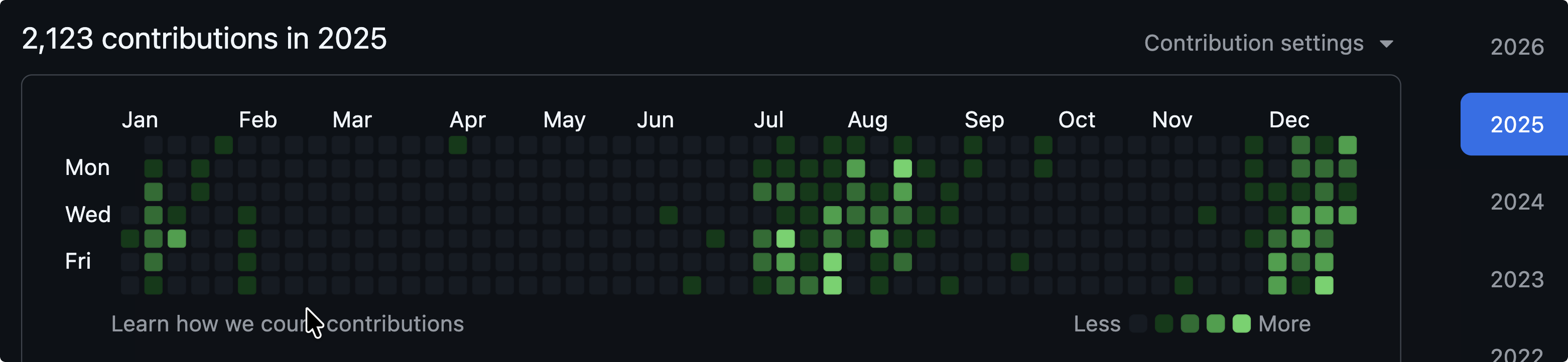
I keep seeing similar commit-graph ramps from people who had stepped away from coding. Peter Steinberger (steipete) describes himself as having “came back from retirement to mess with AI.”[6] In Lex Fridman’s interview intro, this return is framed as coming after roughly three years away from coding.[7] OpenClaw then appears in late November 2025 and grows rapidly.[8]
The Skill That Matters More
As implementation gets commoditized, leverage moves to:
- problem taste
- user empathy
- judgment about what to build
- speed of feedback loops
- expert context in specific domains
- vocabulary and terminology precision
- breadth across fields (generalist advantage)
Right now, one of the biggest multipliers is knowing what to ask for, in exact language.
If you have deeper domain vocabulary, you can prompt with higher resolution and get better outputs. If you are a generalist, you can transfer concepts across domains and unlock combinations other people do not see.
Even language itself becomes leverage: terminology roots, concepts from other languages, and words that do not map cleanly into English can all shape more unique prompts and more unique results.
In other words: ideas are no longer cheap talk if you can execute them immediately.
That is why I am so focused on idea generation right now.
Not because implementation is solved forever.
Because a single good idea can now become a real product before the week is over.
Citations
[1] Printing press - Encyclopaedia Britannica ↩
[2] Jack Dorsey to cut 931 Block workers as AI takes over tasks, memo says - AOL/Business Insider syndication, February 26, 2026 ↩
[3] X post by @jack (status 2027129697092731343) - February 26, 2026 ↩
[4] X post by @karpathy (status 2026731645169185220) - February 25, 2026 ↩
[5] Andrej Karpathy - personal site bio (Tesla Director of AI, OpenAI founding member) ↩
[6] Peter Steinberger (@steipete) GitHub profile - bio line on returning from retirement ↩
[7] Peter Steinberger transcript - Lex Fridman podcast transcript ↩
[8] GitHub API: openclaw/openclaw - repository metadata (created November 24, 2025) ↩
Since November 2025, my relationship to software has changed.
I no longer start from "Do I have enough time and energy to build this?"
I start from "Is this problem worth solving?"
That sounds small, but it is a major shift.
For most of software history, creating an app was expensive, slow, and labor-intensive. Even for experienced developers, new products meant weeks or months of focused effort.
Now, with capable AI agents, the implementation path is cheap enough that the constraint moved upstream. The new bottleneck is idea generation and idea selection.
## A Printing Press Analogy
Before the printing press, books in Europe were copied by hand, one manuscript at a time. In the mid-1400s, Gutenberg's movable-type press removed that copying bottleneck.<sup><a href="#cite-1" id="ref-1">[1]</a></sup>
The analogy to software is not about copying. Software duplication was already cheap.
The bottleneck in software was the human-intensive part: creation, iteration, and verification. Building a useful, trustworthy artifact took a lot of skilled labor.
Capable agents compress that bottleneck. One person can now explore, build, and validate far more ideas per week than before.
That is why this feels like a printing-press moment to me: not because bits can be copied, but because the longest lever available to an individual just got much longer.
## Why I Have More App Ideas Right Now
A friend told me last night: "I work in software, but I still do not know what to build."
I get it. Ideas do not appear from nowhere. My own pipeline is simple:
1. Watch your life for repeated friction.
2. Ask: is this a software-shaped problem?
3. If yes, capture immediately.
4. Revisit later when you have build time.
Most of my ideas are not abstract startup concepts. They are annoyances in my own day:
- tasks I repeat on my phone or computer
- decisions with too much manual overhead
- moments where I think "why is this still not an app"
Another pattern: one seed idea often generates the next few ideas.
When I start building, I discover adjacent problems I could not see at the whiteboard stage. The implementation itself becomes idea generation. Build one tool, notice new friction, spin out the next tool.
Your phone is already a general-purpose computer you carry all day. In many cases, if you cannot do something on it, the blocker is not hardware. The blocker is missing software.
And now, missing software is much easier to create.
## The New Friction: Memory, Not Implementation
Implementation got faster than my ability to remember ideas.
I can now build a functional demo in a few hours, and often reach a publishable version in a week. But ideas arrive faster than that.
So my real bottleneck is capture.
I am building a voice-first note app (working title: Voice Pad) for exactly this reason. I want to splat ideas out of my head the second they appear, then review, rank, and implement them later.
Voice capture does two things for me:
- preserves the raw idea before context fades
- frees working memory for deeper thinking
I told a friend it feels like some ideas leave my head the moment I walk through a doorway. This app, Voice Pad, helps me solve that very real problem.
## A Signal From February 26, 2026
Today (February 26, 2026), Jack Dorsey posted that Block is moving to a "smaller and flatter" structure while leaning harder on AI tools. Business Insider reported a memo targeting an eventual reduction of roughly 40% in workforce size.<sup><a href="#cite-2" id="ref-2">[2]</a></sup> The original X post is here:<sup><a href="#cite-3" id="ref-3">[3]</a></sup>
If you date the capable-agent inflection point to around November 2025, this shift shows up only about four to five months later.
<blockquote class="twitter-tweet"><p lang="en" dir="ltr">Today, we made some org changes, including eliminating roles and beginning the consultation process in countries where required. These changes are reducing our org by roughly 40% over the next few years to get to about 7k people, while continuing to grow gross profit.<br><br>Why now?<br><br>Our company goals have shifted... <a href="https://t.co/gxPEA84eUe">pic.twitter.com/gxPEA84eUe</a></p>— jack (@jack) <a href="https://twitter.com/jack/status/2027129697092731343?ref_src=twsrc%5Etfw">February 26, 2026</a></blockquote> <script async src="https://platform.twitter.com/widgets.js" charset="utf-8"></script>
Whether every company follows the same path or not, directionally the shift is clear: AI capability is now materially changing how software teams are staffed and how fast products can ship.
One day earlier, on February 25, 2026, Andrej Karpathy wrote that programming changed in the "last 2 months" and the break happened "specifically this last December."<sup><a href="#cite-4" id="ref-4">[4]</a></sup> Karpathy is a leading AI researcher, former Director of AI at Tesla, and a founding member of OpenAI.<sup><a href="#cite-5" id="ref-5">[5]</a></sup>
<blockquote class="twitter-tweet"><p lang="en" dir="ltr">It is hard to communicate how much programming has changed due to AI in the last 2 months: not gradually and over time in the "progress as usual" way, but specifically this last December. There are a number of asterisks but imo coding agents basically didn’t work before December…</p>— Andrej Karpathy (@karpathy) <a href="https://twitter.com/karpathy/status/2026731645169185220?ref_src=twsrc%5Etfw">February 25, 2026</a></blockquote> <script async src="https://platform.twitter.com/widgets.js" charset="utf-8"></script>
That lines up with my own experience: late November to early December 2025 is when coding agents crossed from "interesting demo" to "daily production tool" for me.

I keep seeing similar commit-graph ramps from people who had stepped away from coding. Peter Steinberger (steipete) describes himself as having "came back from retirement to mess with AI."<sup><a href="#cite-6" id="ref-6">[6]</a></sup> In Lex Fridman's interview intro, this return is framed as coming after roughly three years away from coding.<sup><a href="#cite-7" id="ref-7">[7]</a></sup> OpenClaw then appears in late November 2025 and grows rapidly.<sup><a href="#cite-8" id="ref-8">[8]</a></sup>
## The Skill That Matters More
As implementation gets commoditized, leverage moves to:
- problem taste
- user empathy
- judgment about what to build
- speed of feedback loops
- expert context in specific domains
- vocabulary and terminology precision
- breadth across fields (generalist advantage)
Right now, one of the biggest multipliers is knowing what to ask for, in exact language.
If you have deeper domain vocabulary, you can prompt with higher resolution and get better outputs. If you are a generalist, you can transfer concepts across domains and unlock combinations other people do not see.
Even language itself becomes leverage: terminology roots, concepts from other languages, and words that do not map cleanly into English can all shape more unique prompts and more unique results.
In other words: ideas are no longer cheap talk if you can execute them immediately.
That is why I am so focused on idea generation right now.
Not because implementation is solved forever.
Because a single good idea can now become a real product before the week is over.
## Citations
<p id="cite-1">[1] <a href="https://www.britannica.com/technology/printing-press" target="_blank" rel="noopener noreferrer">Printing press</a> - Encyclopaedia Britannica <a href="#ref-1">↩</a></p>
<p id="cite-2">[2] <a href="https://www.aol.com/news/jack-dorsey-cut-931-block-203803111.html" target="_blank" rel="noopener noreferrer">Jack Dorsey to cut 931 Block workers as AI takes over tasks, memo says</a> - AOL/Business Insider syndication, February 26, 2026 <a href="#ref-2">↩</a></p>
<p id="cite-3">[3] <a href="https://x.com/jack/status/2027129697092731343" target="_blank" rel="noopener noreferrer">X post by @jack (status 2027129697092731343)</a> - February 26, 2026 <a href="#ref-3">↩</a></p>
<p id="cite-4">[4] <a href="https://x.com/karpathy/status/2026731645169185220" target="_blank" rel="noopener noreferrer">X post by @karpathy (status 2026731645169185220)</a> - February 25, 2026 <a href="#ref-4">↩</a></p>
<p id="cite-5">[5] <a href="https://karpathy.ai/" target="_blank" rel="noopener noreferrer">Andrej Karpathy</a> - personal site bio (Tesla Director of AI, OpenAI founding member) <a href="#ref-5">↩</a></p>
<p id="cite-6">[6] <a href="https://github.com/steipete" target="_blank" rel="noopener noreferrer">Peter Steinberger (@steipete) GitHub profile</a> - bio line on returning from retirement <a href="#ref-6">↩</a></p>
<p id="cite-7">[7] <a href="https://lexfridman.com/peter-steinberger-transcript/" target="_blank" rel="noopener noreferrer">Peter Steinberger transcript</a> - Lex Fridman podcast transcript <a href="#ref-7">↩</a></p>
<p id="cite-8">[8] <a href="https://api.github.com/repos/openclaw/openclaw" target="_blank" rel="noopener noreferrer">GitHub API: openclaw/openclaw</a> - repository metadata (created November 24, 2025) <a href="#ref-8">↩</a></p>